
SLOPES
SAFETY TIPS
Guidelines for enjoying ski resorts and backcountry safely
Able Hakuba Goryu Ski Resort is a member resort of the world-class Hakuba Valley. To help everyone enjoy the ski resort and backcountry safely, we provide safety information in line with the common Hakuba Valley guidelines.
Please review the following important information and enjoy a safe and pleasant winter holiday.

01
Pay attention to “boundary” and “closed area” signs.
Poles marked with yellow and black at the top indicate “boundary” signs, while poles marked in yellow indicate “closed area” signs.
Observance of signs, ropes, and boundaries are prescribed by “Safety Standards for Snow Sports” which is a rule common throughout all ski resorts in Japan. It is skiers’ and snowboarders’ obligation to check the map, grasp the boundaries and closed areas, and ski or snowboard only on permitted trails. If you are not sure about boundaries, please ask the ski patrol or ski resort staff.
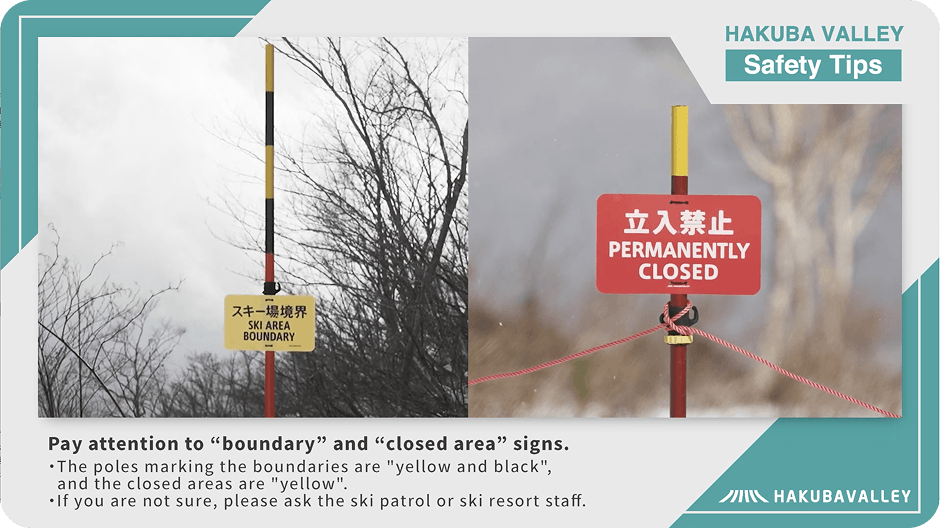
“Boundary” SIGN
“Closed area” SIGN
02
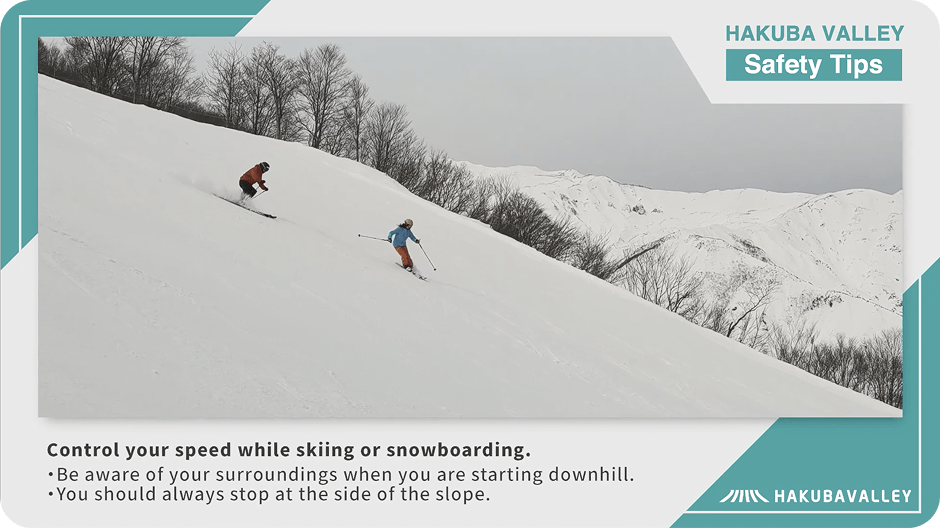
Control your speed while skiing or snowboarding.
Collisions usually happen because skiers or snowboarders are sliding too fast. The most important thing regarding safety is to control your speed and acknowledge the situation around you and to avoid risks. In addition, meeting points of trails, chair lift top, and base areas are designated as “slow zones”. Be sure to slow down sufficiently in these areas. To help prevent accidents, make sure to ski or snowboard at a speed that allows you to avoid or stop when necessary. Regarding the importance of speed control, please check and follow the “10 FIS Rules” and “Safety Standards for Snow Sports” for the safety of yourself and your others.
03
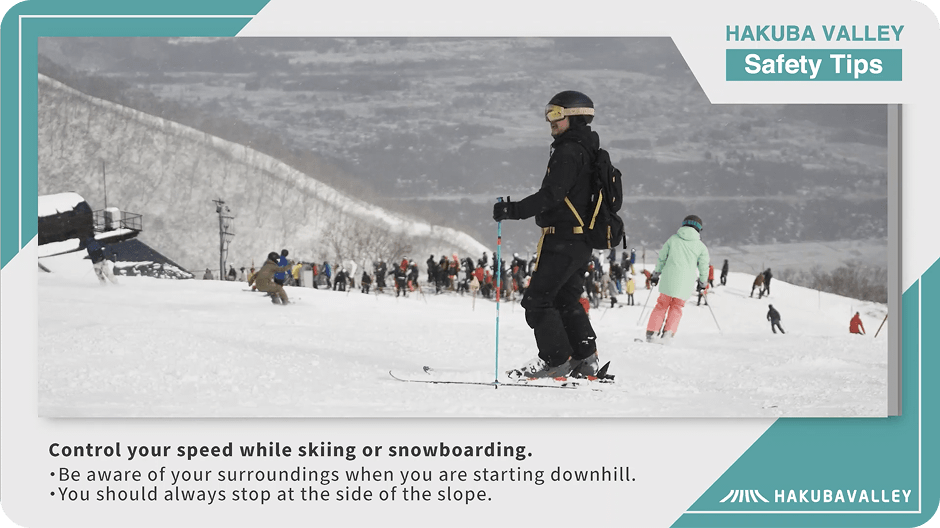
Pay attention to your surroundings and check the situation.
Many collisions occur when you do not fully check your surroundings. Be aware of your surroundings when you are starting downhill and if you need to stop on the slope, move aside and do not stop where you obstruct a trail, or are not visible from above. Also, if you notice children or families skiing, please slow down.
04
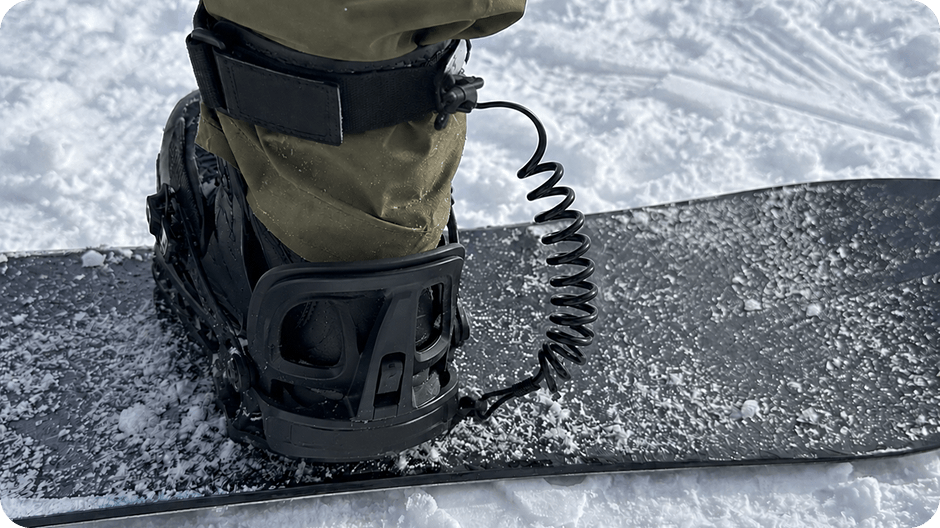
Leashes are mandatory for snowboards.
Leashes prevent boards from accidentally sliding downhill and crashing into people or objects. In the case of a runaway snowboard, the owner of the board will be held liable for any costs associated with injuries and damages caused during the incident. Sitting on your snowboard and riding it like a sled or toboggan is also prohibited.
05
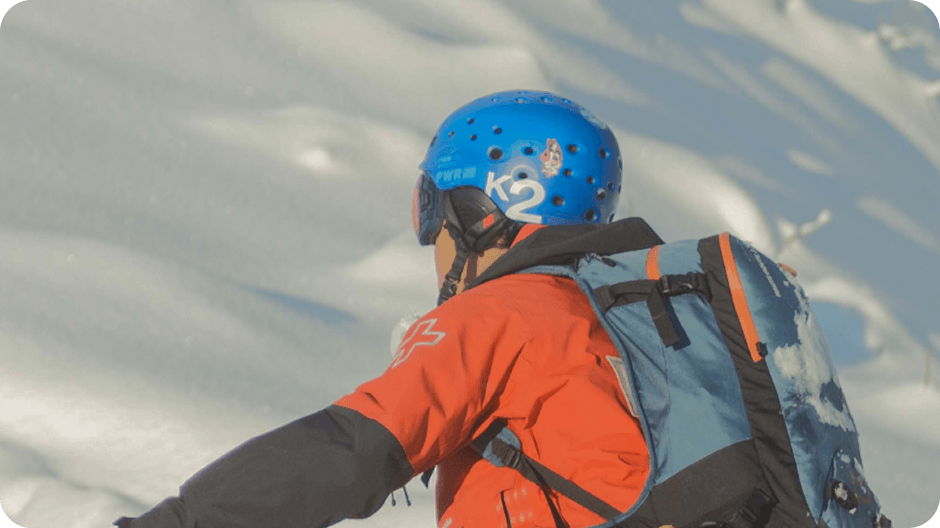
Wearing a helmet is highly recommended.
Wearing a helmet has been proven to reduce serious head injuries. The latest models have become more comfortable, lightweight, breathable, and customizable. It is highly recommended to wear a helmet, especially for children as well as skiers and snowboarders enjoying terrain parks.
06
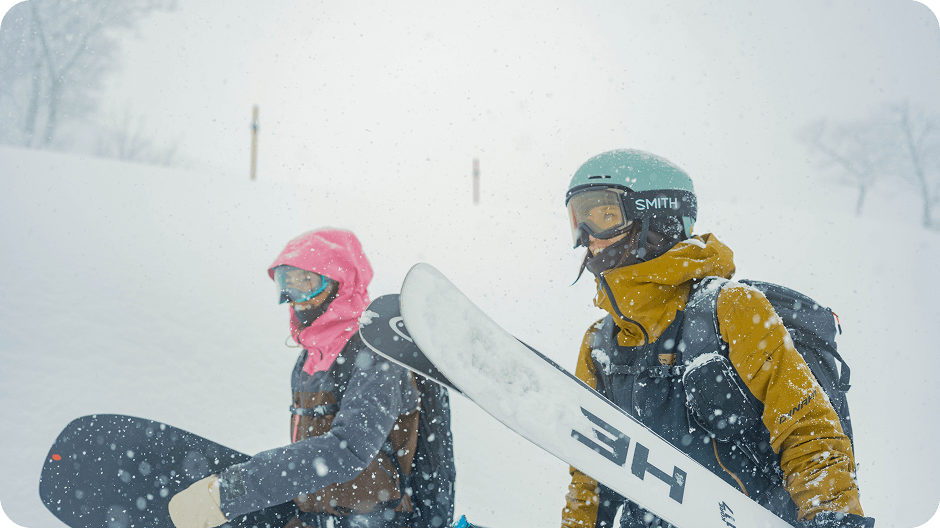
Do not enter deep powder areas alone.
Death caused by suffocation happens in areas of deep snow every year. As for tree runs with deep powder, there are also accidents caused by multiple reasons including tree collisions.
Please bear in mind that it is safer to ski or snowboard with someone when you go for powder or tree runs. A rescue whistle can be useful in an emergency.
07
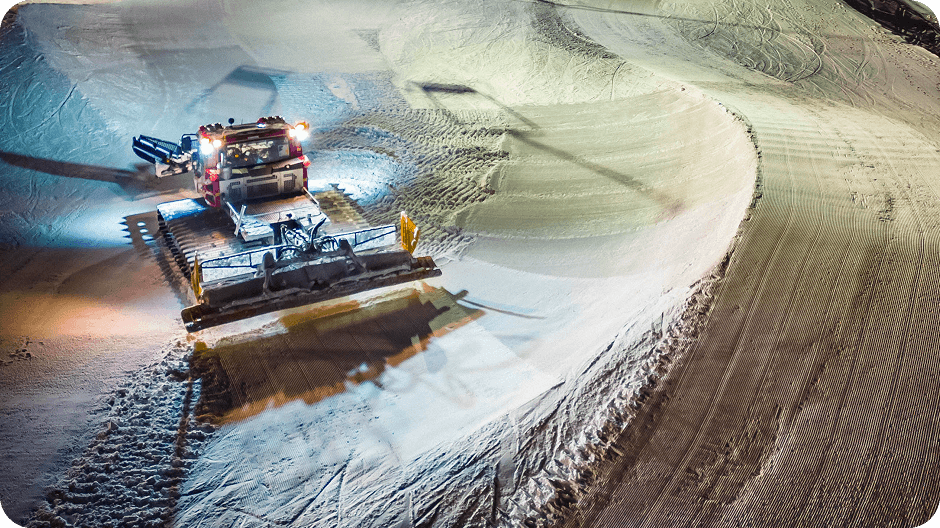
Ski resorts are off-limits outside operating hours.
After operating hours, slopes and courses are dangerous due to snow grooming and snow removal work. Camping outside of designated areas is also prohibited.
08
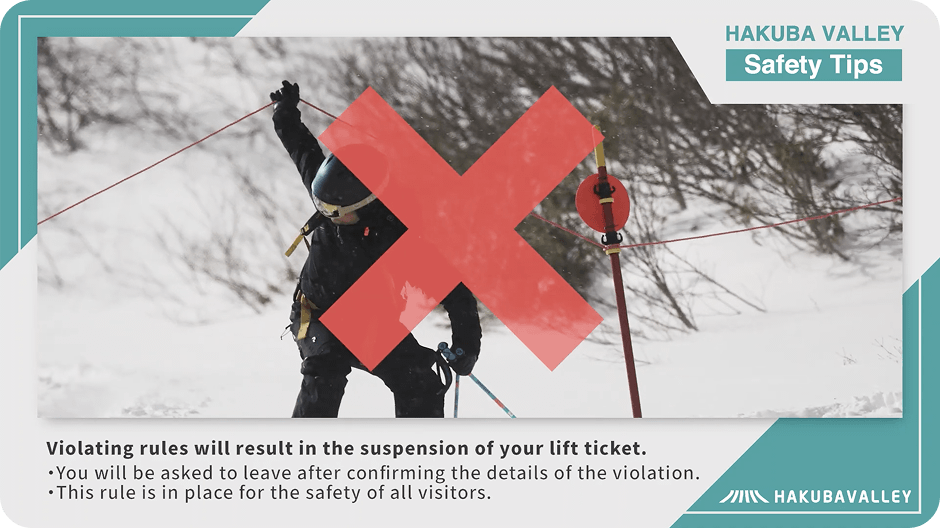
Violating ski resort rules will result in the suspension of your chair lift ticket and you will be asked to leave the resort.
Guests in ski resorts are obliged to present their chair lift tickets if requested by the ski patrol or chair lift staff. Skiers and snowboarders who violate rules will immediately have their chair lift tickets suspended and be asked to leave the resort.
09
Contact ski resort staff immediately in case of emergency.
Please contact ski resort staff or ski patrol as soon as possible when an emergency occurs. There is an emergency telephone number for every ski resort. You can find the telephone number at the ticket office or on the website of each ski resort.
※Able Hakuba Goryu Ski Resort : +81-261-75-2101
10
Check the Terms and Conditions of ski resorts for further information.
Guests at ski resorts are subject to the terms and conditions set by each ski resort. In addition to safety matters, the terms and conditions also include matters regarding your contractual relationship with ski resorts. Please read through them carefully. You can find this information at the ticket office or on the website of each ski resort.
01
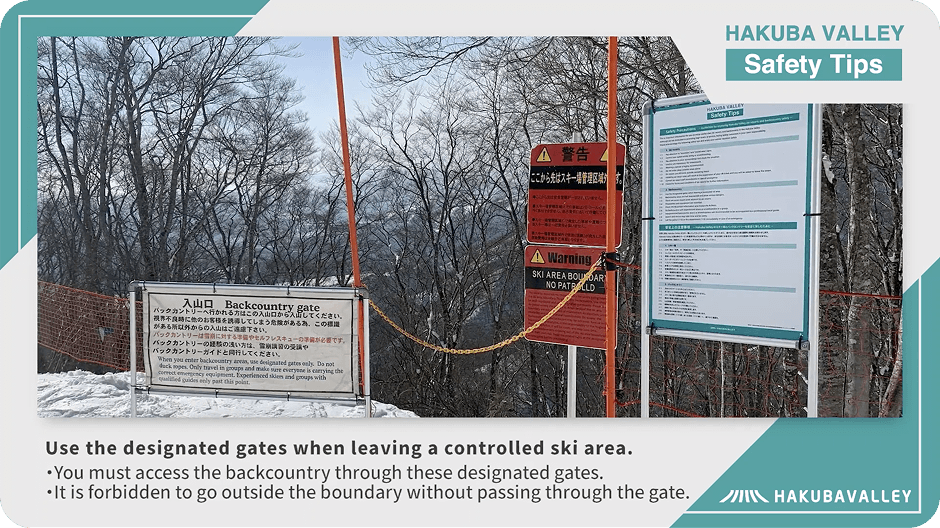
Use the designated gates when leaving a controlled ski area.
Backcountry gates are set up at ABLE Hakuba Goryu, Happo-one, Tsugaike, Hakuba Norikura, and Hakuba Cortina. You must access the backcountry through these designated gates. Backcountry access via Jigatake, Kashimayari, Sanosaka, Hakuba47, and Iwatake is prohibited as these resorts do not have designated gates.
02
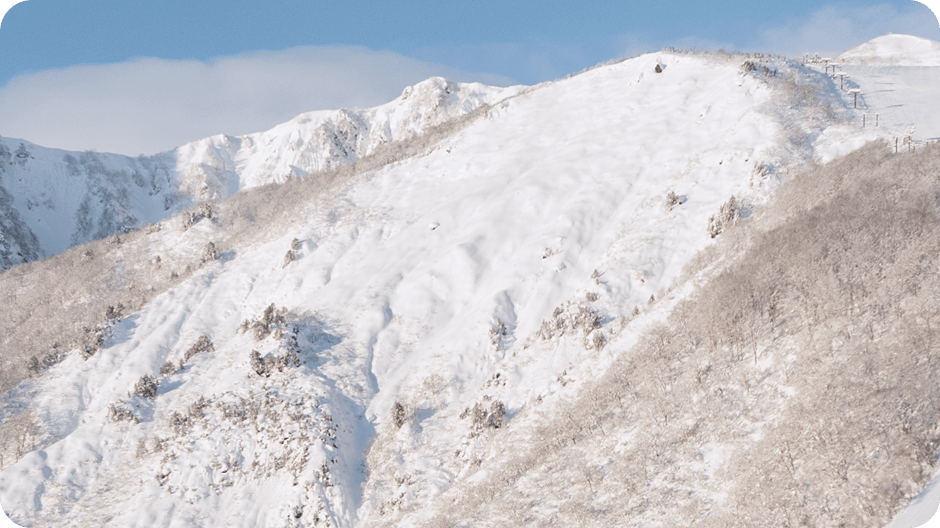
Backcountry areas are not maintained and pose various dangers.
There are different kinds of dangers outside of the controlled ski area, such as avalanches, hidden rocks, obstacles, cracks in snow surfaces, cliffs, gullies, and many more. Even areas as close as 1 metre outside of the resort boundaries are not controlled by ski patrol and are designated as “uncontrolled areas”. Hakuba Valley snow resorts accept no liability for accidents that occur in the backcountry.
03
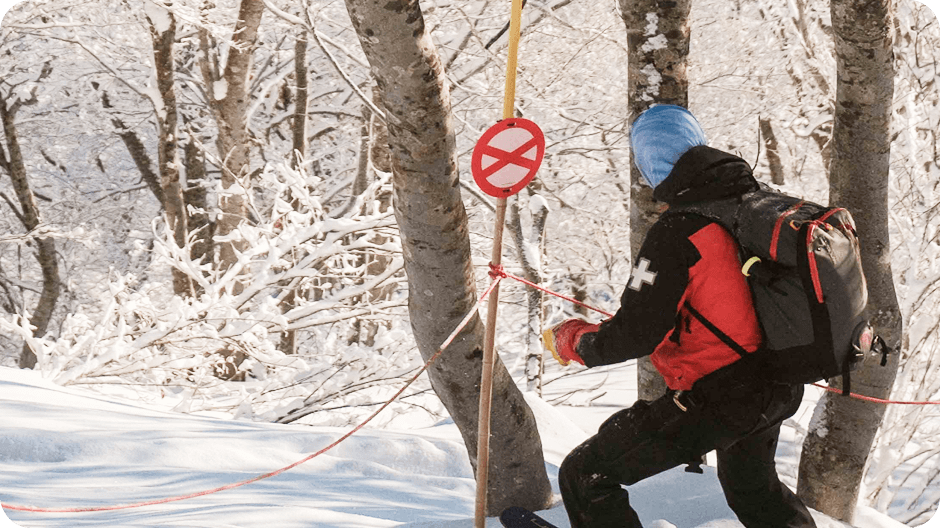
There are some closed areas adjacent to ski resorts.
Due to the risk of severe accidents, some areas adjacent to snow resorts are closed. These areas are closed based on agreements with local administrative and associated organizations. Please respect these closures.
04
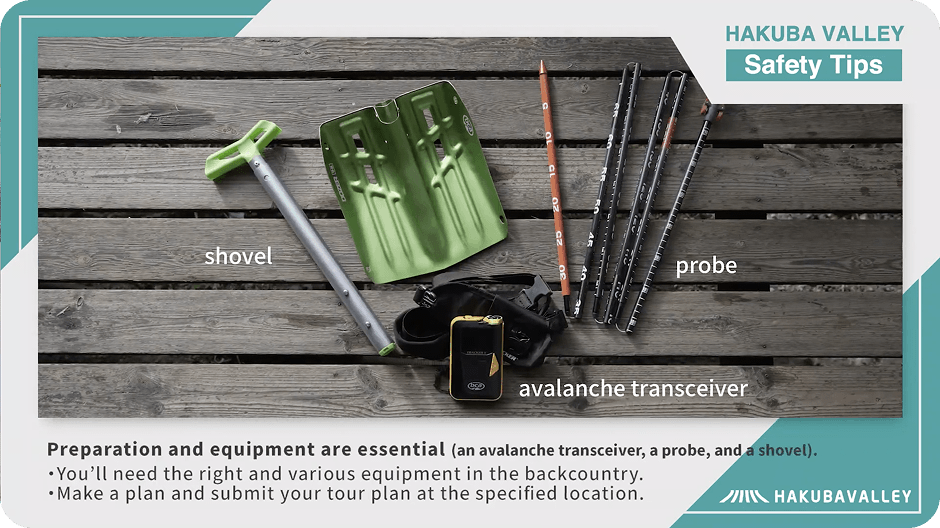
Preparation and equipment are essential.
Regardless of whether you are skiing backcountry with a guide or not, you will need not only an avalanche safety kit (an avalanche transceiver, a probe, and a shovel), but also any essential items for venturing outside the ski resorts. Pre-season training is also important. You are always welcome to the “Nagano Prefecture Comprehensive Mountaineering Center” where they conduct seminars or courses in trekking and outdoor activities for the public. Be sure to submit a Mountain-Climbing Registration Form at a designated ticket window in advance to go outside of the ski resort boundaries or when climbing mountains outside of the resorts. Online submissions are also accepted. The Mountain-Climbing Registration Form must be submitted before purchasing tickets, therefore please print it out or keep a hard copy or download it to your device.
05
Check Mountain Information and Avalanche Bulletin.
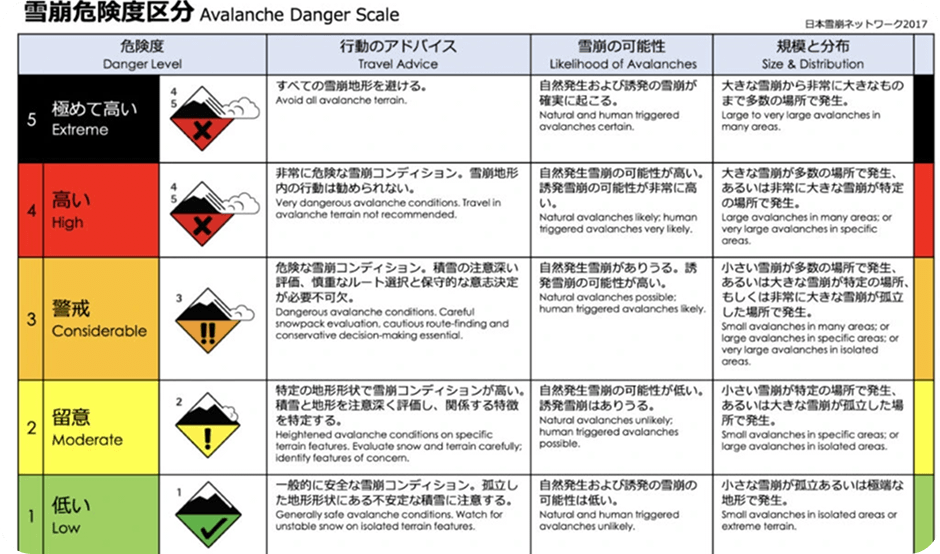
Information can be found via “Mountain Information” by the Nagano Prefectural Police and “Shinshu Mountain Information” by the Nagano Prefecture Association for the Prevention of Mountain Accidents. “Avalanche Information” by the Japan Avalanche Network is updated daily with the latest information. Knowing all types of avalanche risks and where the risks lie will help you to make a safer backcountry tour plan. Once the Avalanche Danger Scale rises to Level 3, inexperienced backcountry skiers and snowboarders are recommended to stay within the resort’s boundaries.You can check the current avalanche risk on the weather information page.
06
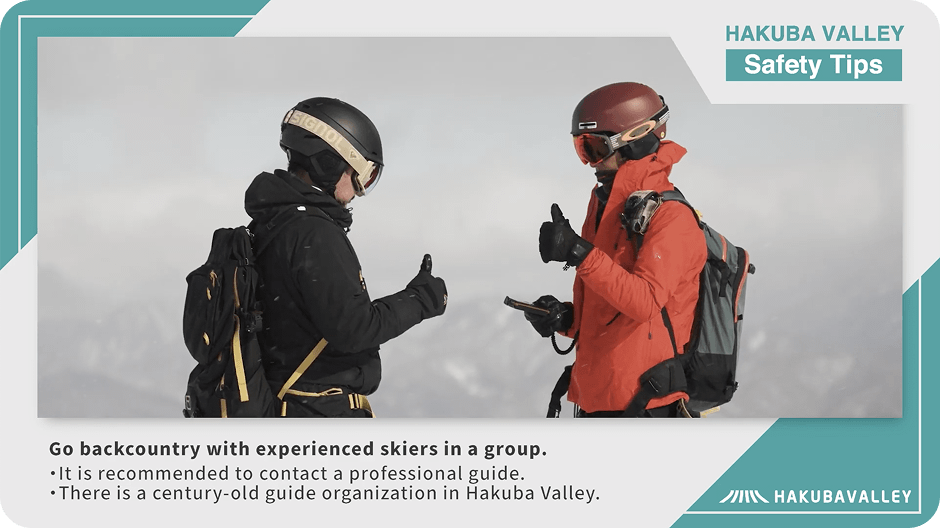
Go backcountry with experienced skiers or snowboarders in a group.
Never go backcountry alone. It becomes more difficult to take leadership and manage risks in a big group, therefore keep your team small and plan your tour route carefully and effectively.
07
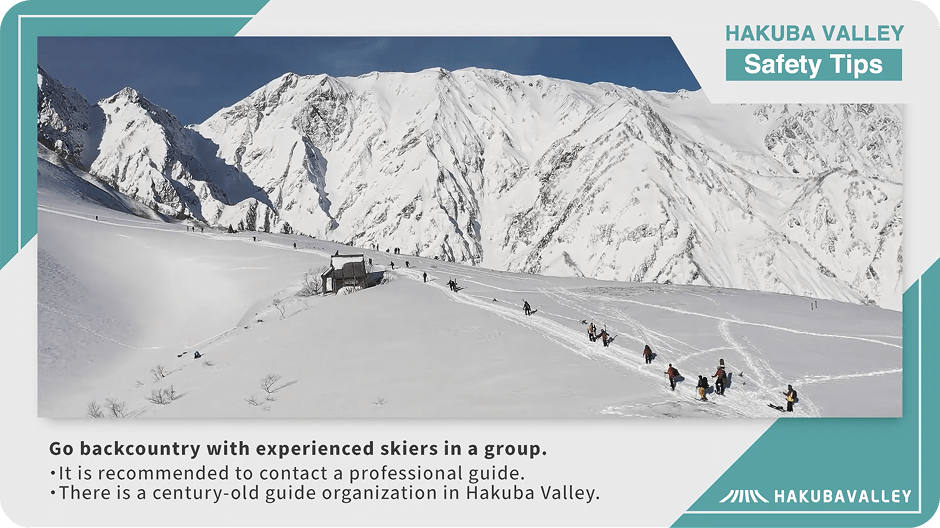
Inexperienced backcountry skiers or snowboarders are recommended to be accompanied by a professional local guide.
There is a century-old “Guide Organization” in Hakuba Valley. For those who want to enjoy skiing or snowboarding safely, it is recommended to contact a professional guide who can manage risks in the backcountry. Although you can find different types of backcountry tour guide companies in Hakuba Valley, please make sure that your guide is certified by a national guide organization recognized by the International Federation of Mountain Guides Association (IFMGA). In Japan, the “Japan Mountain Guides Association” is a member of IFMGA.
08
Search and rescue may take time and be costly.
In the situation that a public helicopter cannot be dispatched due to weather, wind, or other rescue operations, a land rescue will be initiated. If a private rescue team is dispatched due to the accident location or rescue situation, search and rescue expenses shall be borne by the person being rescued. Guests are encouraged to enroll in travel insurance that covers accidents and gear loss or breakage.
09
Call the police (110) or the fire department (119) immediately in case of an emergency.
If you cannot help yourself or there is nobody else that can assist, call the police or fire department as soon as possible. Use the GPS on your smartphone or other devices to advise responders of your current location.